Gas hits $6 a gallon in California; Southwest see increases
National News

Audio By Carbonatix
7:10 PM on Thursday, April 30
(The Center Square) - California Thursday officially exceeded an average gas price of $6 a gallon for the first time since the start of the U.S.-Israel conflict with Iran.
The new high came just one week after a short-lived drop in the cost of a gallon, according to AAA. Various gas stations in California have been near or at the $6 mark for several weeks, but AAA said the average price was hovering below $6 a gallon. That changed on Thursday when AAA reported an average of $6.01 in California, up 16 cents from one week ago, with Mono County along the Nevada border at $6.95.
At the same time, Nevada saw the average price hit $5.13, up 17 cents from one week ago.
Colorado rose to $4.25, up 29 cents in one week, and Arizona was at $4.67, up six cents from April 23.
Drivers throughout the Southwest are seeing some of the nation's highest prices amid the conflict in Iran, which began Feb. 28. The average U.S. gas price has gone up nearly $1.50 since the start of 2026.
California consistently has had the nation's highest gas average for several years, and that remained the case on Thursday as the entire country deals with spikes in prices during the Mideast conflict.
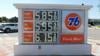
Gas prices near $6 a gallon in Simi Valley, California
Gas prices start at $5.859 a gallon at a Union 76 station in Simi Valley, Calif., April 30, 2026. The average price of gas in the state hit $6.01 that day. Photo: Dave Mason / The Center Square
“It’s a really unpredictable situation the way that things are emerging,” said Patrick De Haan, Gas Buddy head of petroleum analysis
“A lot of the direction for gas prices is going to be very significantly impacted by the conditions moving forward – whether the Strait [of Hormuz] is closed or reopened," De Haan told The Center Square Thursday. "It’s very hard to predict.”
Despite what AAA called a “bit of relief at the pump” just last week as the average price per gallon neared $4, gas prices have surged once again across the U.S. The average gas price nationally was $4.30 a gallon Thursday, up 27 cents a gallon from one week ago, with WTI Crude oil prices having recently rushed past $100 once again. The result is more uncertainty over gas prices.
“There was an overnight shift of about 11 cents,” AAA Northern California spokesperson Doug Johnson told The Center Square of the first spike earlier this week. “And I think that's the market reacting to the United Arab Emirates on Tuesday saying it would leave OPEC.”
The United Arab Emirates is one of 12 members of the Organization of the Petroleum Exporting Countries, the oil cartel that heavily influences the global price for oil. OPEC says it's one of the world’s largest oil producers.
The fluctuation of prices is "showing destabilization in the oil markets, and anytime there's any sort of destabilization, as we saw in the conflict in Iran, that can have an impact on prices at the pump locally," Johnson said.
There is still some distance to be covered before the national average reaches the all-time high of $5.02 per gallon, set in summer 2022. But four months ago, the average price was $2.82.
“Stable national average to start the year, lowest since 2021,” read the AAA headline at the time. Since then, the average price of a gallon of gas has increased by $1.49.
While less visible to consumers, the biggest impact of the sharp rise in gas prices this year could be felt from the near all-time high price of diesel.
The current average gallon is $5.50, which was $3.52 in January according to the U.S. Energy Information Administration. The all-time high of $5.82 was set in the summer of 2022.
Johnson said that two Bay Area California cities, San Francisco and San Rafael, broke an all-time national record earlier this month by breaking $8 for a gallon of diesel.
“The U.S. economy is powered by diesel from trains and trucks to tractors, so the elevated price of diesel is going to impact the economy in a pretty negative way here in the weeks ahead as prices remain just below their all-time record highs,” De Haan said. “This is likely to lead to a rise in inflation here in the months ahead.”
With summer nearly here and Memorial Day on May 25, many Americans are still expected to take road trips and flights despite the higher fuel prices, according to AAA. Along with checking that your car is fully serviced and running smoothly, Johnson said driving speed can have a major impact on fuel efficiency.
“Fuel economy peaks at around 50 miles per hour on most cars, and then as you start to drive faster, it decreases,” said Johnson. “So if you drive the recommended speed limit, you can actually increase your fuel economy between 7-14%.”