Panel: Congress has power to buck SCOTUS birthright citizenship ruling
National News

Audio By Carbonatix
3:13 PM on Friday, September 18
Thérèse Boudreaux
(The Center Square) – As the Trump administration continues to pursue ways to quell “birth tourism,” legal scholars are probing potential actions Congress could take to rewrite the common interpretation of the 14th amendment’s citizenship clause.
The clause states that “all persons born or naturalized in the United States, and subject to the jurisdiction thereof, are citizens of the United States.”
That phrase has been interpreted over the last 150 years to guarantee citizenship to any child born in the United States – with a few exceptions – regardless of whether the mother is residing in the country legally.
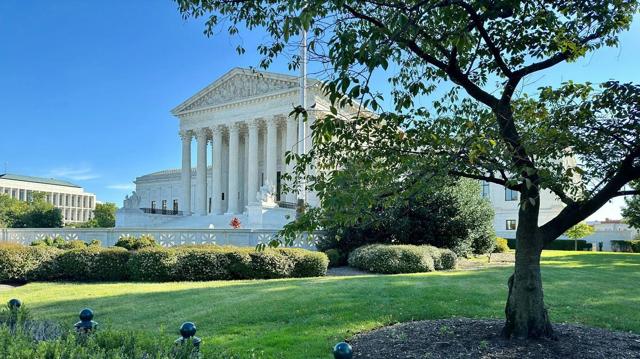
The U.S. Supreme Court affirmed that interpretation in June in Trump v. Barbara, with Chief Justice John Roberts stating that the phrase "subject to the jurisdiction thereof" refers to the United States' power to govern anyone living in its territory.
Critics of the court’s ruling disagree, arguing that the clause does not mean territorial jurisdiction, but national jurisdiction, which requires allegiance to the U.S. government
They further argue that the 14th amendment was meant to apply only to American citizens and recently freed slaves, not illegal immigrants or tourists who come to the U.S. explicitly to have children.
“This was an outcome-oriented decision, in my opinion. This is not a decision that was actually grounded in originalism,” Gene Hamilton, president of the America First Legal Foundation, said Friday in a webinar hosted by the Federalist Society.
“It's not a decision that was grounded in anything other than wanting to avoid an awkward political outcome by certain members of the Court.”
“[I]t's weird to me — to put it bluntly — to consider someone being subject to the jurisdiction thereof as implying simply that their mere presence in the United States…means that [they] are a member of the body politic, and [their] children should be citizens, and that there is nothing that could ever change that,” Hamilton added.
As of 2017, an estimated 4.5 million children under the age of 18 born to illegal immigrants were living in the U.S., according to the Federation for American Immigration Reform. An estimated 225,000 to 250,000 were born in 2023 alone, according to the Center for Immigration Studies.
U.S. Court of Appeals Judge for the Second Circuit Steven Menashi, another guest in the panel, disagreed with Hamilton. He argued that “to understand a rule that is fixed to apply differently under different circumstances is not really an odd result or non-originalist in any way.”
“We say the Second Amendment doesn't just apply to muskets, and so it might also be that the principle in the [citizenship] clause doesn't only apply to the categories to which it applied at the time,” Menashi posited.
Both Hamilton and Menashi agreed, however, that if Congress disagrees with the ruling, lawmakers can likely utilize their legislative powers to either work around the ruling or at least force the court to revisit its interpretation.
“[If the circumstances under which somebody receives citizenship can't be limited, then maybe Congress or the executive branch might try to reclaim some of the authorities about regulating citizenship,” Menashi noted.
“And that's not inconsistent with Barbara, right? Because Barbara is just about who receives citizenship. It's not about the degree to which citizenship could be regulated once conferred.”
“[A]ll that we need is a vehicle to get before the Supreme Court to get them to reconsider the decision,” Hamilton added. “Congress could still pass a law…and ultimately, that's just going to cue up another case or controversy for the Supreme Court to adjudicate and decide. But Congress still ultimately has the power to do whatever it wants.”